
Malaysia is placing one of the biggest bets in its economic history: billions of ringgit in data-centre investment, a sovereign AI cloud, and a stated ambition to rank among the world’s top 20 AI nations by 2030. But behind the investment headlines sit harder questions — about power, water, jobs, and who actually benefits from the boom. In this article, we look at the context behind Malaysia’s AI push, the gap between individual and business adoption, and what it means for Malaysian organizations deciding where they fit in the AI economy.
The Ambition: An “AI Nation” by 2030

Budget 2026 allocated RM5.9 billion to accelerate AI adoption and infrastructure, including RM2 billion earmarked for a sovereign AI cloud that reduces reliance on foreign platforms. ILMU, Malaysia’s first homegrown large language model, launched in August 2025. This builds on the National AI Roadmap (2021–2025), which prioritised AI across manufacturing, healthcare, agriculture and public services — the current push carries the same agenda with a much larger budget and sharper urgency.
The Build-Out: Johor Becomes the Region’s Data-Centre Hub
Malaysia’s data-centre market is growing at a 22.4% CAGR, and Johor has become Southeast Asia’s fastest-growing hub — capacity nearly doubled to roughly 5.8 gigawatts by mid-2025, driven by proximity to Singapore’s subsea cable landing points. Global hyperscalers including Amazon, Google, Microsoft, Oracle and TikTok have committed over USD 15 billion combined, and the flagship RM20 billion Nvidia-YTL AI Cloud partnership reached a construction milestone within 22 months.
Shifting Priorities: Policy Is Quietly Getting Choosier
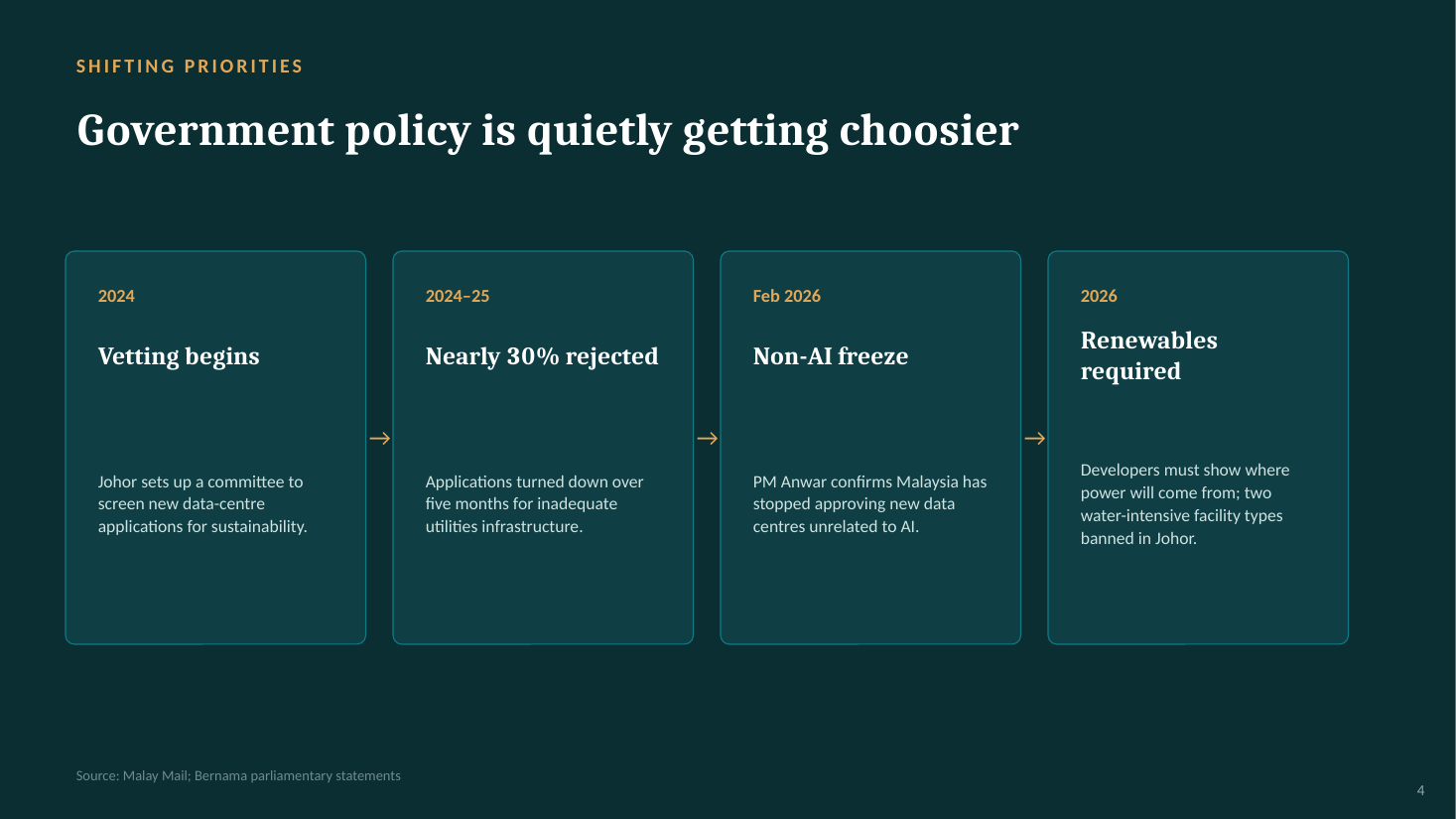
The era of approving everything is over. Johor set up a vetting committee in 2024 to screen new data-centre applications for sustainability, and nearly 30% of applications were rejected over five months for inadequate utilities infrastructure. In February 2026, the Prime Minister confirmed Malaysia has stopped approving new data centres unrelated to AI. Developers must now show where their power will come from, and two water-intensive facility types have been banned in Johor.
The Physical Cost — and the Pushback on the Ground
A single 50-megawatt facility can consume as much water as 2,200 households and as much electricity as 22,000 households per day — and Johor’s pipeline, even under stricter vetting, could still rise eightfold to an estimated 7,000 megawatts. In February 2026, residents of Iskandar Puteri staged the first protests of their kind in Malaysia over data-centre construction, triggered by drops in water pressure, construction dust and the loss of greenery to land clearing. Some operators are responding with treated wastewater for cooling, closed-circuit systems, and solar making up over half of on-site power at select sites — but the debate has since become politicised in Selangor as well.
Winners So Far: Big Capital and Big Tech
The clearest beneficiaries to date are global hyperscalers (cheaper land and power, tax incentives, fast-tracked approvals), state and federal government (investment headlines, projected jobs and GDP contribution), large developers and utilities such as YTL and Tenaga Nasional (multi-billion ringgit contracts), and well-resourced large firms — financial services and retail are furthest along in practical AI deployment. Google’s data-centre and cloud investment alone is projected to add 26,500 jobs and over USD 3 billion to the economy by 2030.
The Adoption Gap: Individuals Race Ahead, Businesses Lag Behind
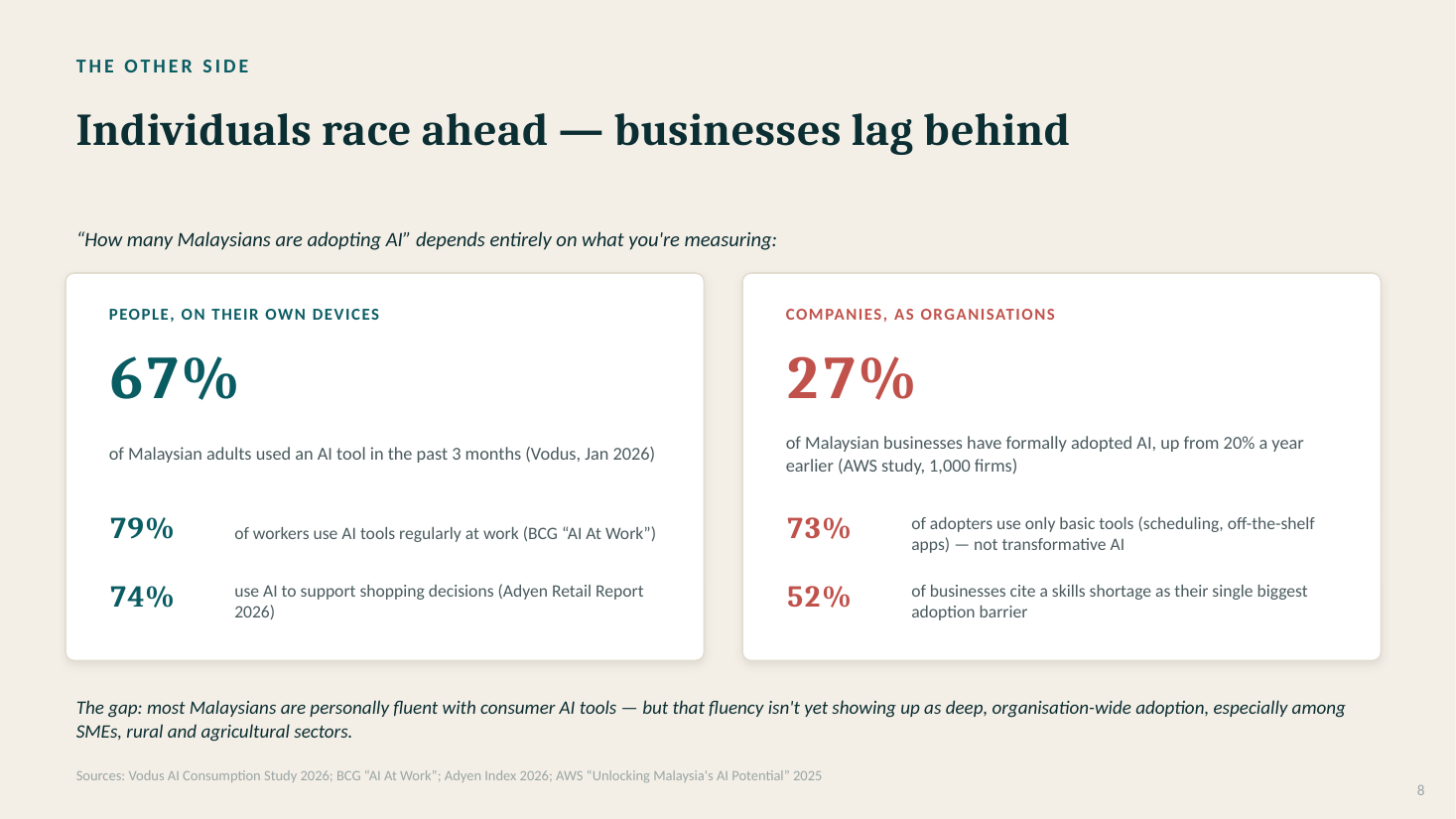
How many Malaysians are adopting AI depends entirely on what you measure. As individuals: 67% of Malaysian adults used an AI tool in the past three months (Vodus, Jan 2026), 79% of workers use AI tools regularly at work (BCG), and 74% use AI to support shopping decisions (Adyen, 2026). As organizations: only 27% of Malaysian businesses have formally adopted AI — up from 20% a year earlier (AWS study of 1,000 firms) — and 73% of those adopters use only basic tools rather than transformative AI, with 52% citing a skills shortage as their single biggest barrier. Most Malaysians are personally fluent with consumer AI tools, but that fluency is not yet showing up as deep, organisation-wide adoption — especially among SMEs and rural and agricultural sectors.
Closing the Gap: Government Support for Businesses
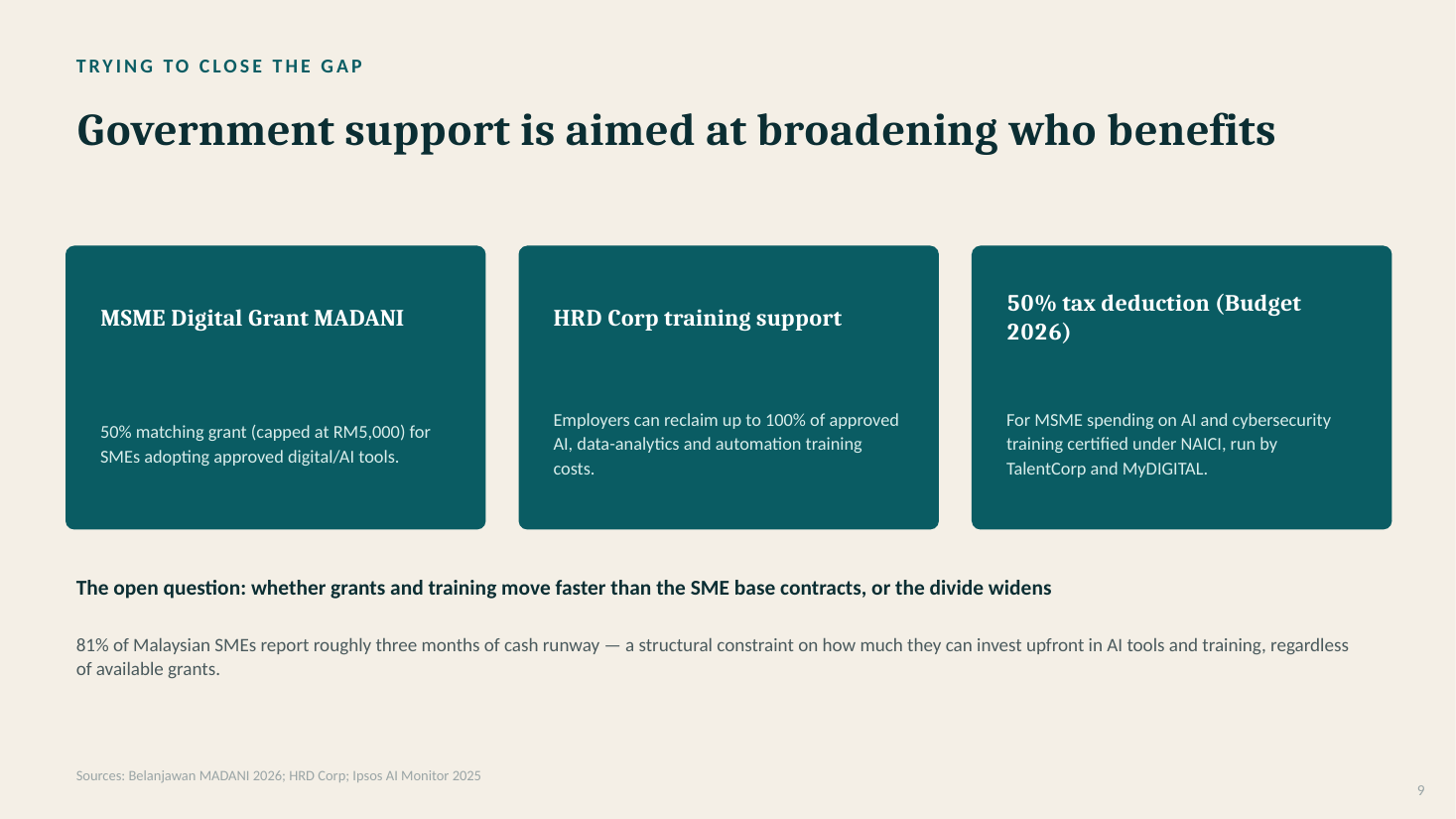
Several schemes aim to broaden who benefits. The MSME Digital Grant MADANI offers a 50% matching grant (capped at RM5,000) for SMEs adopting approved digital and AI tools. HRD Corp lets employers reclaim up to 100% of approved AI, data-analytics and automation training costs. Budget 2026 added a 50% tax deduction for MSME spending on AI and cybersecurity training certified under NAICI. The open question is whether grants and training move faster than the constraint on the ground: 81% of Malaysian SMEs report roughly three months of cash runway, which limits how much they can invest upfront regardless of available support.
The Central Tension: Growth vs. Equity vs. Sustainability
Malaysia is winning the regional race for AI and data-centre capital — the investment, jobs headlines and sovereign-AI ambitions are real. But that growth is straining local power and water supplies and testing community goodwill, and the benefits are concentrated so far: hyperscalers, large developers and big firms move first, while most SMEs, rural communities and lower-skilled workers are not yet inside the AI economy. The question the title poses — who will be prioritised — is still being answered, one approval, protest and budget line at a time.
Don’t Watch the AI Economy From the Outside — equalOne Can Get You In
The adoption gap is also an opportunity: Malaysian businesses that move from basic tools to real, organisation-wide AI workflows now will be ahead of the 73% still on the basics. For businesses of all sizes, equalOne stands as a trusted monday.com partner, offering a range of monday.com services tailored to unique needs — including AI-powered workflows, automations and governed rollouts that qualify as practical, transformative adoption. Contact us today and experience efficiency, innovation, and growth with equalOne by your side.