
Choosing a work management platform means filtering a lot of marketing claims. Independent analyst research and large-scale user reviews are some of the most useful filters available. Here is a summary of what Gartner, Forrester and the major peer-review sites say about monday.com this year, with a focus on its AI features.
Gartner: a Leader four years running
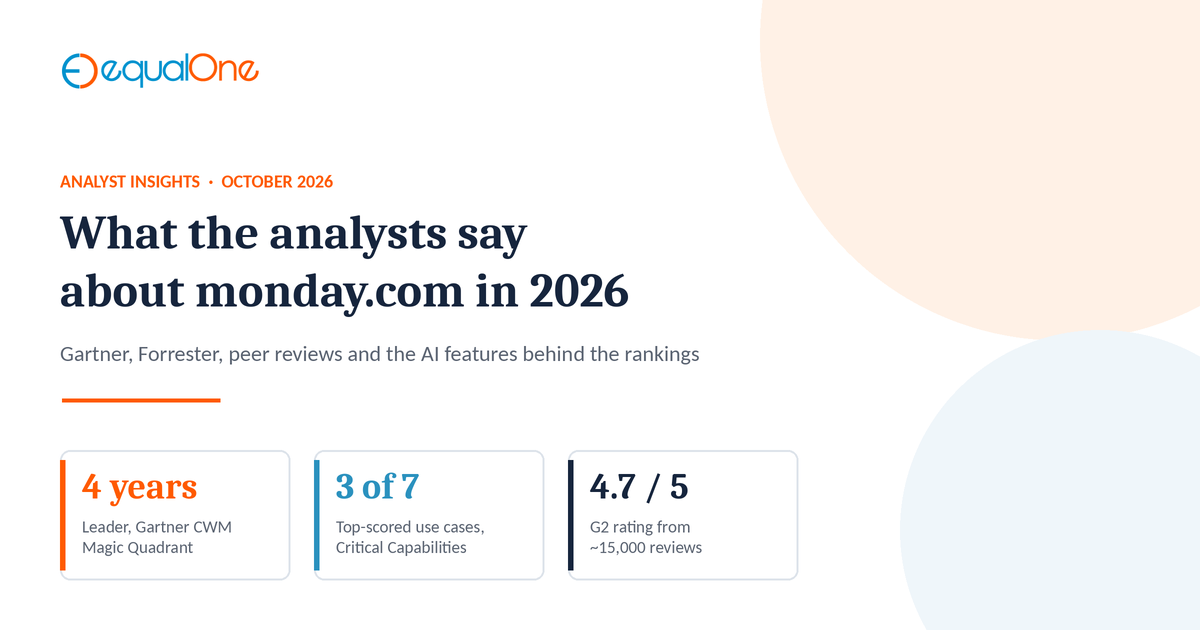
Gartner’s latest Magic Quadrant for Collaborative Work Management (CWM) is the main headline. monday.com has been named a Leader in the 2026 report for the fourth consecutive year. The report was authored by Nikos Drakos, Joe Mariano, Lacy Lei and Hironori Hayashi and published on 5 October 2026. monday.com has held Leader status every year since Gartner first published the report.
Its position within the quadrant is also notable. monday.com reports that, for the second consecutive year, it was placed furthest on Completeness of Vision and highest on Ability to Execute. The 2025 edition was the first time it reached that position on both axes. These placement details come from monday.com’s own announcement. Readers who want to verify them can request the full report from monday.com.
See the Magic Quadrant graphic: monday.com offers complimentary access to the 2026 Gartner Magic Quadrant for Collaborative Work Management. Read the announcement and access the report.
monday.com is not the only Leader. Smartsheet also announced that it was named a Leader in the 2026 Magic Quadrant. The field has also grown: the 2026 report evaluates Adobe, Asana, Atlassian, ClickUp, Meister, monday.com, Quickbase, Smartsheet, Superhuman, Teamwork.com and Wrike. Gartner describes a market where CWM platforms increasingly connect team productivity with operational work and AI-supported execution, and it compares vendors on automation, governance and specialised work.
Critical Capabilities: where monday.com scored highest
Gartner’s companion Critical Capabilities report gives more practical detail. In 2026, monday.com was the highest-scoring vendor in three of the seven use cases evaluated: Work Planning and Execution; Intake, Triage and Service Operations; and Product Management Operations. It also placed among the three highest-scoring vendors across all seven use cases.
The Magic Quadrant is not limited to CWM. In 2025, monday.com was the only work management platform recognised as a Leader across three Gartner Magic Quadrants: Marketing Work Management Platforms, Collaborative Work Management, and Adaptive Project Management and Reporting. More recently, monday.com was recognised in the 2026 Gartner Magic Quadrant for Sales Force Automation for the second time, which reflects the growth of monday CRM.
Forrester: a more measured view
Forrester’s most recent evaluation is a useful counterweight. The Forrester Wave: Collaborative Work Management Tools, Q2 2025 evaluated 11 vendors: Adobe, Airtable, Asana, Atlassian, ClickUp, monday.com, Quickbase, ServiceNow, Smartsheet, Wrike and Zoho. monday.com was included, but the Leaders named in that Wave were Adobe and Asana.
Forrester’s market guidance applies to any buyer. It advises that the best value comes from integration capabilities, that data quality matters for AI, and that CWM is not yet a replacement for project portfolio management (PPM) tools. Forrester also notes that portfolio management at scale needs more robust data models, governance and scalability, and these capabilities are still maturing in many CWM platforms.
What users say
Peer reviews give a ground-level view. On G2, monday Work Management holds a 4.7 out of 5 rating from nearly 15,000 reviews. On Capterra, monday.com rates 4.6 from more than 6,000 reviews. In G2’s comparison with Asana, reviewers highlight monday.com’s user-friendly interface, which lets team members adapt quickly without formal training.
Gartner Peer Insights reviewers raise real limitations too. One reviewer finds that reporting covers the basics but is not polished enough to share with stakeholders and senior management. Another is frustrated by having to pay extra, on top of the subscription, for small features such as time tracking that they consider fundamental.
The AI story analysts are rewarding
AI is now central to monday.com’s positioning. Over the past year, the company committed fully to what it calls the AI Workspace, where people and AI agents plan and execute work on a shared, governed data and workflow layer. The main components are:
- monday agents, which act directly on platform data and workflows and handle tasks end to end alongside the teams they support.
- monday sidekick, a personal AI assistant for in-the-moment work. It has been out of beta since January 2026 and is now the central entry point for AI in monday.com.
- monday vibe, monday.com’s answer to the vibe-coding trend, which lets users build custom apps from prompts.
- monday magic, which helps users build complete solutions within monday.com at no credit cost.
- monday MCP, which connects external AI assistants to the same data, so teams can create items, run analyses and generate reports from the assistant they already use.
The catch: budgeting for AI credits
Buyers need to plan for how AI is priced. AI credits are the unit of measure for AI usage across the monday AI portfolio. Usage of monday agents is tiered by task complexity: simple tasks use about 10–50 credits, intermediate tasks about 50–150, complex tasks about 150–250, and extra-complex tasks more than 250. Since 20 July 2026, sidekick messages have also consumed credits, based on the complexity of each interaction. Some capabilities, such as monday magic and monday MCP, do not consume credits.
In practice, AI costs now scale with use. Organisations rolling out agents broadly should model credit consumption before they commit.
What this means for your organisation
The analyst consensus is that monday.com is one of the strongest platforms in collaborative work management. It leads Gartner’s rankings, offers an AI roadmap with clear direction, and receives consistently high ratings for ease of use. Forrester’s more cautious placement and the user criticisms of reporting depth and add-on costs are a reminder that fit still depends on your specific requirements.
At Equalone, we recommend testing three things before committing. First, check how well monday.com’s reporting meets your leadership’s needs. Second, run a pilot of AI agents on a real workflow to measure both value and credit consumption. Third, confirm that the integrations your processes depend on are available. Analyst rankings are a strong starting point, but they don’t replace a pilot run on your own workflows.
Talk to Equalone about evaluating or optimising monday.com for your team.
Sources: Gartner, Magic Quadrant for Collaborative Work Management, N. Drakos, J. Mariano, L. Lei, H. Hayashi, 5 October 2026; Gartner, Critical Capabilities for Collaborative Work Management, 5 October 2026; monday.com press release, 8 October 2026; Forrester, The Forrester Wave: Collaborative Work Management Tools, Q2 2025, M. Visitacion, 3 June 2025; G2, Capterra and Gartner Peer Insights user reviews; monday.com support documentation on AI credits.
Gartner and Magic Quadrant are registered trademarks of Gartner, Inc. and/or its affiliates. Gartner does not endorse any vendor, product or service depicted in its research publications, and does not advise technology users to select only those vendors with the highest ratings or other designation. Gartner research publications consist of the opinions of Gartner’s research organisation and should not be construed as statements of fact. Forrester does not endorse any company, product, brand or service included in its research publications.