
AI adoption has moved from boardroom ambition to front-page anxiety. In CNA’s Talking Point forum “Is AI Really To Blame For Recent Layoffs?” (2026), retrenched workers, employers and panelists laid out what AI-driven change actually looks like on the ground — the fear, the data, and the outcomes on both sides of the employment relationship. In this article, we distil the key insights from that discussion: what employees and employers actually gain from AI adoption, the four stages of AI fluency, and how the monday.com AI Work Platform gives organizations a structured path through them.
Credit: The insights and figures in this article are drawn from CNA’s Talking Point forum “Is AI Really To Blame For Recent Layoffs?” (2026).
The Context: The Fear Is Real — But So Is the Data
The anxiety around AI and jobs is widespread, not isolated. In Q1 2026, 3,800 workers were retrenched in Singapore — the highest in four quarters — with PMETs (Professionals, Managers, Executives and Technicians) hit hardest. The first-ever national AI adoption report surveyed more than 2,500 Singapore firms. Behind the numbers are people: one retrenched content creator described feeling “very redundant” after learning AI had absorbed her workflow.
Yet the data also puts the fear in proportion: only 6.2% of firms reported reduced headcount linked to AI adoption — a real but modest slice of the workforce, provided the transition is handled with a human-centric approach. For employers, the lesson is that the emotional toll of AI-driven change is a real cost. Budget for it alongside the financial case, not after it.
Why Employers Actually Turn to AI
AI is rarely the sole reason someone loses a job — but it is rarely innocent either. Panelists named three distinct drivers behind AI-related restructuring. The first is company efficiency: process, hiring and operational changes as AI reshapes how work already gets done. The second is a shift of investment: some roles are let go because the organization is investing in and hiring for different capabilities. The third is new capability: AI lets companies generate outputs they simply couldn’t before, so the nature of the job itself changes.
Employee Outcomes of AI Adoption
AI as a Capable Assistant — Not a Replacement
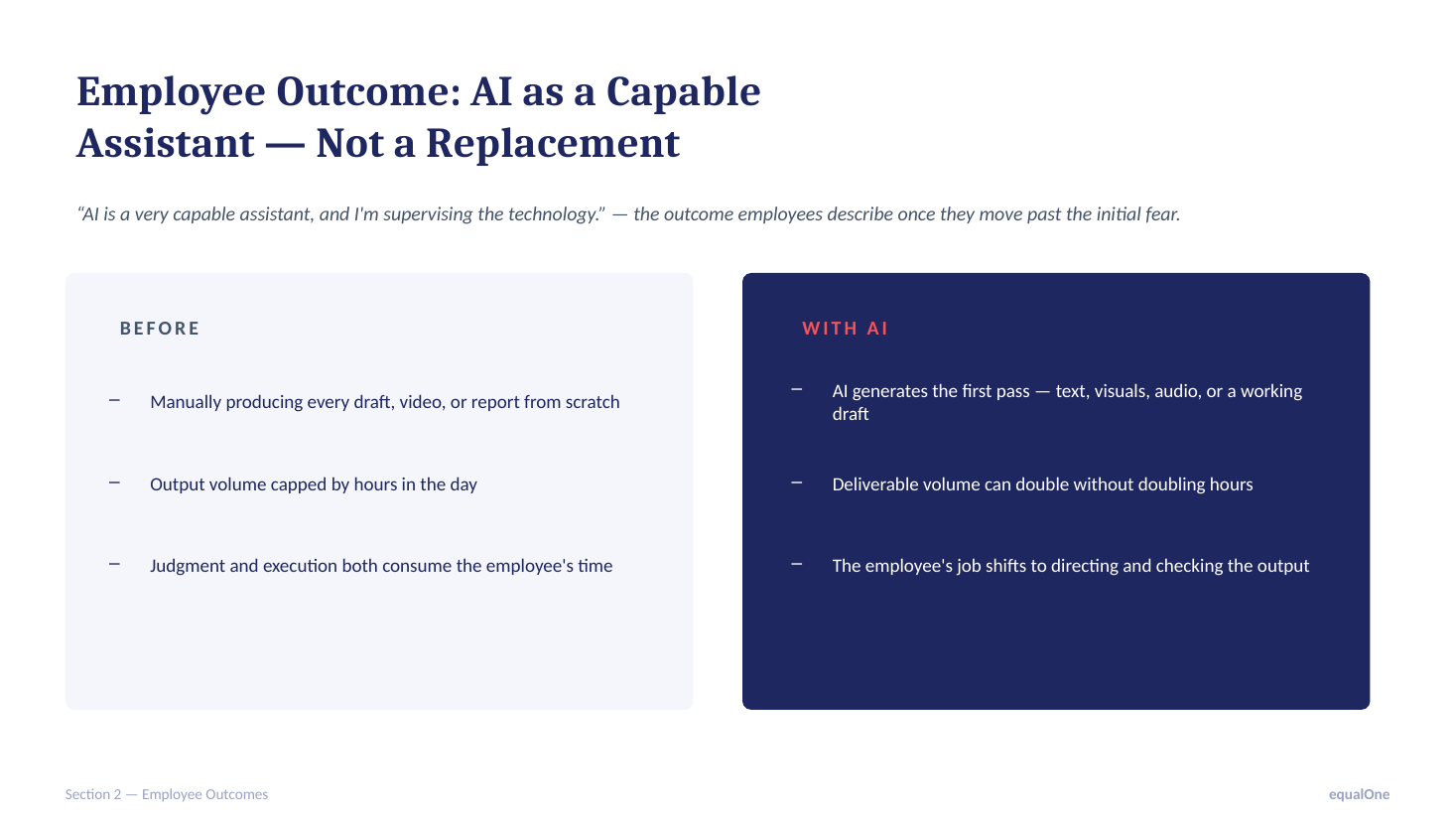
Once employees move past the initial fear, the outcome they describe is supervision, not substitution: “AI is a very capable assistant, and I’m supervising the technology.” Before AI, every draft, video or report was produced manually from scratch, and output volume was capped by hours in the day. With AI, the technology generates the first pass — text, visuals, audio or a working draft — deliverable volume can double without doubling hours, and the employee’s job shifts to directing and checking the output.
The Mid-Career Advantage
Age is not the deciding factor in AI readiness — years of domain expertise are. Experienced staff instantly recognize good versus flawed AI output, while junior staff may prompt AI faster but cannot yet judge whether the answer is right. Panelists estimated a mid-career professional could reach working AI fluency in about three months of guided practice. For employers, experienced staff are an underused accelerant for AI rollout, not a liability to manage around.
Employer Outcomes: Train Up, Don’t Just Cut
The guidance unions are giving companies already going full-steam on AI is simple: “Cut costs to save jobs — not cut jobs to save cost.” Bring the workforce up to speed rather than replace it outright. A rising share of Singapore job postings now list AI skills as a requirement — a first-ever national labour market signal of how fast demand is moving. The training pathway employers are building runs across the whole career ladder: juniors learn core AI-assisted tasks under supervision, mid-career staff apply domain expertise to judge and refine AI output, and seniors own AI-augmented processes end-to-end while mentoring others.
The Four Stages of AI Fluency
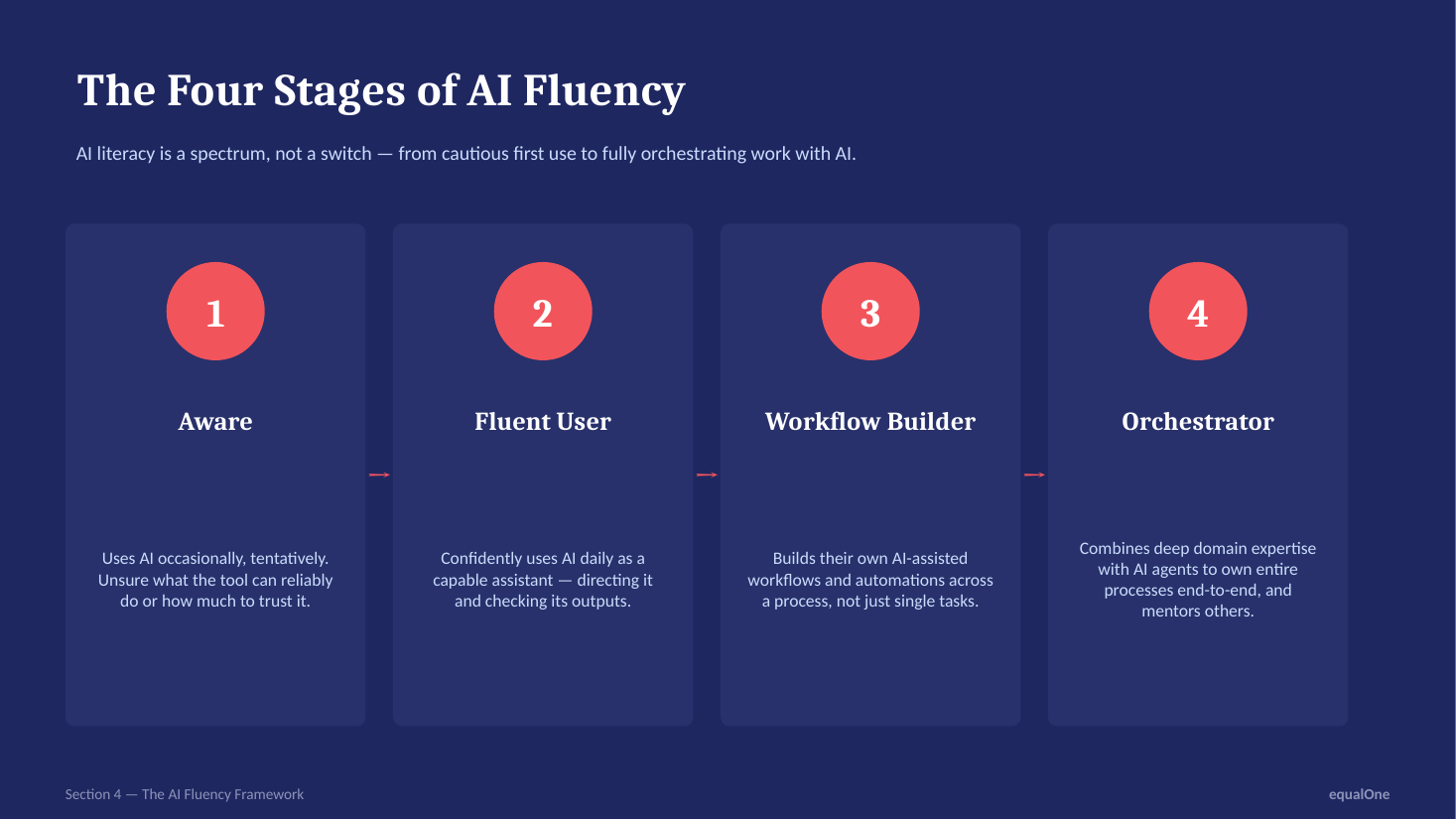
AI literacy is a spectrum, not a switch. The forum framed it as four stages. Stage 1 is Aware: using AI occasionally and tentatively, unsure what the tool can reliably do. Stage 2 is Fluent User: confidently using AI daily as a capable assistant — directing it and checking its outputs. Stage 3 is Workflow Builder: building your own AI-assisted workflows and automations across a process, not just single tasks. Stage 4 is Orchestrator: combining deep domain expertise with AI agents to own entire processes end-to-end, and mentoring others.
How Fast Can People Actually Get There?
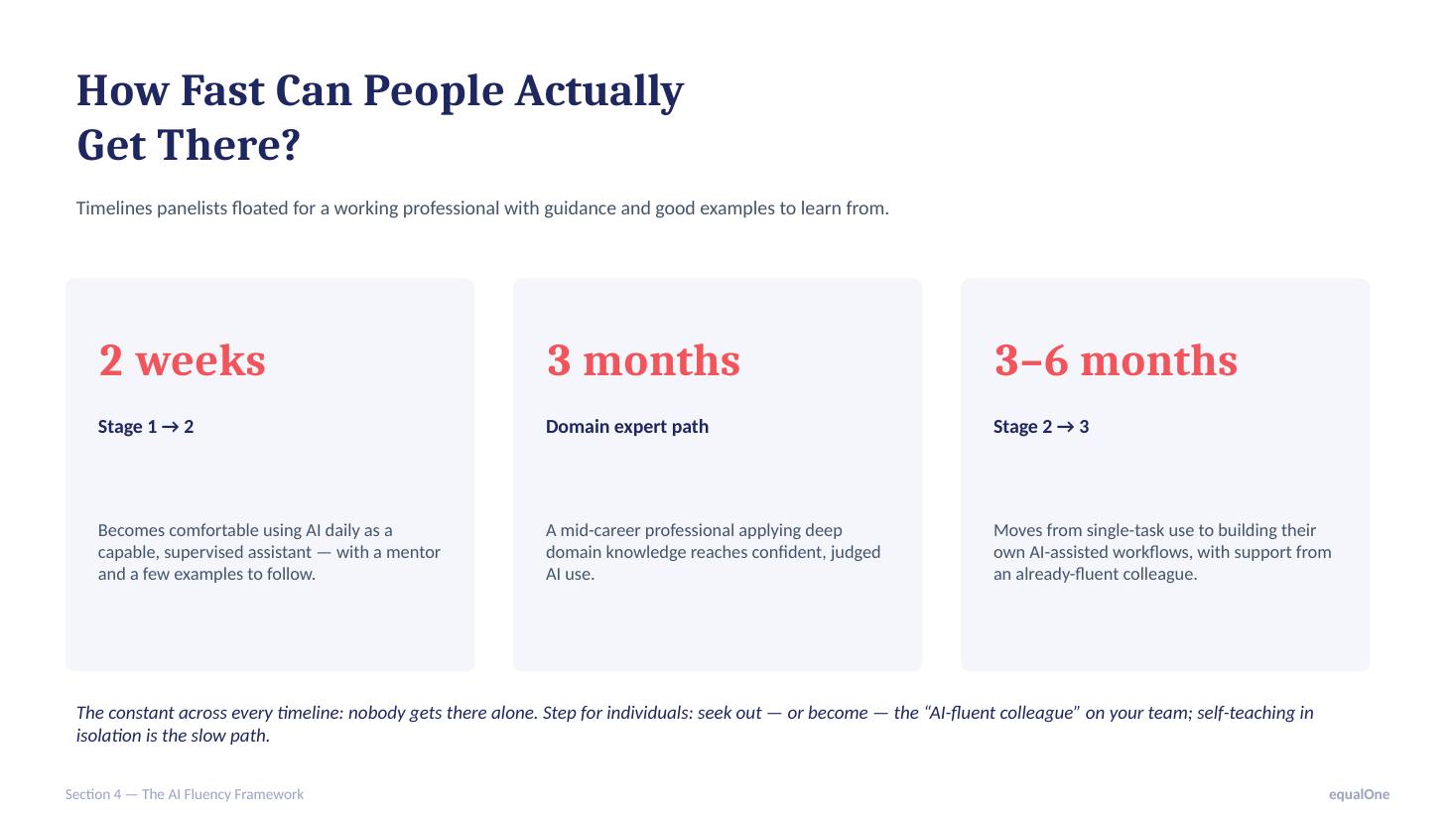
With guidance and good examples, the timelines are shorter than most people expect. Moving from Stage 1 to Stage 2 takes about two weeks with a mentor and a few examples to follow. A mid-career professional applying deep domain knowledge reaches confident, judged AI use in about three months. Moving from Stage 2 to Stage 3 — from single-task use to building your own AI-assisted workflows — takes three to six months with support from an already-fluent colleague. The constant across every timeline: nobody gets there alone. Seek out — or become — the AI-fluent colleague on your team; self-teaching in isolation is the slow path.
monday.com: A Ready-Made Path Through the Fluency Stages
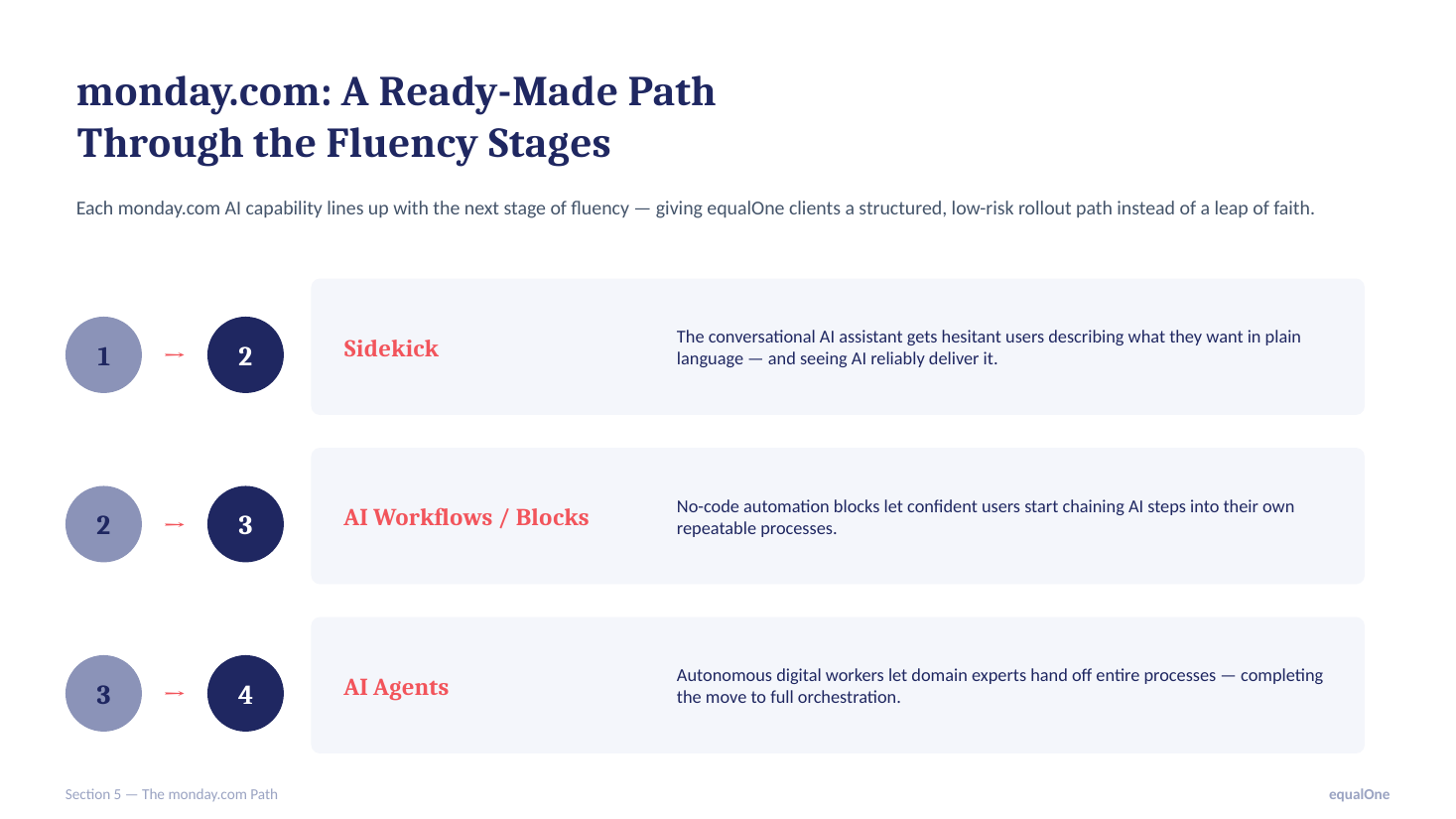
Each AI capability of the monday.com AI Work Platform lines up with the next stage of fluency — giving organizations a structured, low-risk rollout path instead of a leap of faith. Sidekick, the conversational AI assistant, moves people from Stage 1 to 2 by letting hesitant users describe what they want in plain language and see AI reliably deliver it. AI Workflows and no-code automation blocks move confident users from Stage 2 to 3 by letting them chain AI steps into their own repeatable processes. And AI Agents — autonomous digital workers — complete the move from Stage 3 to 4 by letting domain experts hand off entire processes to full orchestration.
What This Means for Your Organization
Outcomes, not features, are what employees and employers actually experience from AI adoption — and the rollout that works starts by knowing where your people already stand. Assess where teams sit today; most staff are at Stage 1 or 2, not further. Match the intervention to the stage: Sidekick for hesitant users, Workflows for confident ones, Agents for domain experts ready to orchestrate. Frame it as training, not threat — “cut costs to save jobs” — paired with a visible pathway from junior to senior. And let experienced staff lead: their domain depth is the fastest route to trustworthy AI output, not a barrier to it.
Ready to Map Your AI Rollout? Look No Further Than equalOne
For businesses of all sizes, equalOne stands as a trusted monday.com partner, offering a range of monday.com services tailored to unique needs. With a team of experienced consultants and experts, equalOne helps you map your AI rollout on the monday.com AI Work Platform — stage by stage, from first Sidekick conversation to fully orchestrated AI Agents. Contact us today and experience efficiency, innovation, and growth with equalOne by your side.