Composed by ChanLoong B.
Kuala Lumpur is having its moment as a regional AI capital this week. The World AI Show returned to the city for its 48th global edition on 9–10 September 2026, gathering policymakers, enterprise leaders, and investors at the DoubleTree by Hilton Kuala Lumpur to talk about what comes after the hype: execution.
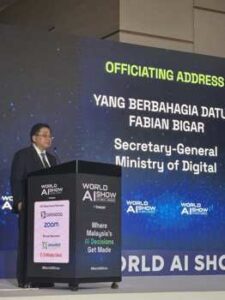
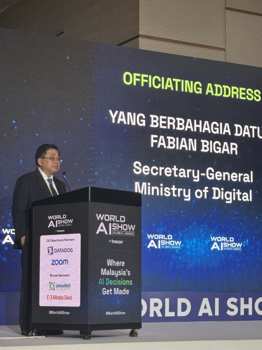
Delivering one of the event’s most closely watched keynotes was Datuk Fabian Bigar, Secretary-General of Malaysia’s Ministry of Digital and one of the chief architects of the country’s AI Nation 2030 vision. In his address, Datuk Fabian laid out three strategic decisions the Malaysia MADANI government has made to move the country from an AI adopter to an AI-driven, AI-governing nation: the corporatisation of AI Malaysia Berhad, the National AI Action Plan 2026–2030, and the introduction of MY AI SAFE (the Malaysia AI Safety Institute) as the backbone of the country’s AI governance framework.
Taken together, these three moves signal something notable: Malaysia isn’t just publishing another AI strategy document. It’s building the institutions, the roadmap, and the guardrails needed to run one. Here’s what each of them actually means.
1. Corporatisation of AI Malaysia Berhad
The first — and arguably most structural — decision is the formal corporatisation of AI Malaysia Berhad as a permanent national AI entity under the Ministry of Digital.
This isn’t a brand-new agency built from scratch. It’s the institutionalisation of the National AI Office (NAIO), which was originally set up in December 2024 and had been operating out of MyDIGITAL Corporation. Prime Minister Dato’ Seri Anwar Ibrahim officially announced the establishment of AI Malaysia Berhad on 28 July 2026, describing it as a key catalyst for realising the AI Nation 2030 aspiration under the Thirteenth Malaysia Plan (13MP) and the Malaysia MADANI framework.
Digital Minister YB Gobind Singh Deo framed the move as a way to comprehensively integrate policy coordination and execution at the national level — in other words, closing the gap between writing AI policy and actually delivering it across ministries and agencies. As a corporatised entity rather than a temporary office, AI Malaysia Berhad now carries a broader, whole-of-government mandate across five core responsibilities:
- Policy coordination and implementation — bridging national strategy with operational delivery
- High-impact monitoring — tracking outcomes under the National AI Action Plan
- Trusted AI governance — developing frameworks, codes of ethics, standards, and trust mechanisms
- Strategic collaboration — coordinating global AI partnerships
- National AI safety — housing the Malaysia AI Safety Institute function
To fulfil this mandate, AI Malaysia Berhad operates across six strategic functions, from strategy, policy and foresight to sector-by-sector implementation — effectively becoming Malaysia’s single point of accountability for AI at the national level. Academics have welcomed the move as a necessary evolution: as Universiti Teknologi Malaysia’s Prof. Ts. Dr. Mohd Naz’ri Mahrin noted, the corporatisation continues an agenda that began with the National AI Roadmap in 2021 and matured through NAIO, and it now needs to act as a catalyst agency aggressive enough to dismantle the barriers still slowing Malaysia’s “Made by Malaysia” AI ambitions.
For businesses, the practical takeaway is this: there is now one institutional address for AI policy engagement in Malaysia, rather than a patchwork of overlapping initiatives.
2. The National AI Action Plan 2026–2030
The second decision — and the one that gives the corporatisation its marching orders — is the National AI Action Plan 2026–2030, unveiled alongside AI Malaysia Berhad’s launch as a five-year roadmap for the country’s AI ambitions.
The plan is explicit about its ambition: Malaysia isn’t positioning itself as a mere AI adopter, but as a regional leader shaping how AI is governed and deployed across Southeast Asia. It’s structured around 14 sectoral initiatives and 14 enabling initiatives, organised under five interlinked pillars:
- Talent development — expanding AI literacy among the general public while building the specialised talent pool industries need
- Policy development — bridging research and industry so AI solutions move from lab to real-world deployment
- Digital and data infrastructure — providing the computing capacity and infrastructure government and businesses need to build and deploy AI securely
- Responsible governance — establishing the trust, safety, and regulatory foundations for AI adoption
- Sustainable investment — anchoring long-term, market-driven funding into the AI ecosystem
This isn’t happening in isolation. The plan builds on Malaysia’s earlier National AI Governance & Ethics Guidelines (AIGE), launched in September 2024, which set out seven voluntary principles — fairness, reliability and safety, privacy and security, inclusiveness, transparency, accountability, and human-centricity — for AI users, regulators, and developers. The 2026–2030 plan effectively operationalises that ethical foundation into funded, time-bound initiatives with institutional owners.
Notably, the plan also feeds into Malaysia’s regional ambitions. The country is leading the proposed ASEAN AI Safety Network, and the National AI Action Plan is designed to demonstrate to the rest of ASEAN what a “whole-of-nation” AI agenda — talent, infrastructure, governance, and capital moving together — can look like in practice.
3. MY AI SAFE: Anchoring the AI Governance Framework
The third decision addresses the question every fast-moving AI market eventually has to answer: who checks that the technology is safe, and how?
Malaysia’s answer is MY-AISafe, the Malaysia AI Safety Institute, launched alongside AI Malaysia Berhad to strengthen the country’s technical capability to assess and manage AI risk. Rather than sitting as a purely advisory body, MY-AISafe is built around three pillars:
- AI RDCI (Research, Development, Commercialisation, and Innovation) — covering safety evaluations, testing, and AI red-teaming
- Strategic collaboration — talent development, expertise-sharing, and technology transfer with national and international partners
- Governance, safety, and regulatory support — developing standards, risk management frameworks, and compliance guidance
In practical terms, MY-AISafe gives regulators and organisations a technical partner to turn to when evaluating, managing, and mitigating the risks that come with deploying AI systems — from model testing to red-teaming exercises conducted in coordination with government agencies, industry, academia, and research institutions.
Crucially, MY-AISafe isn’t meant to operate in a legal vacuum for long. It sits alongside a proposed, risk-based AI Governance Bill that is currently open for public consultation and targeted for completion by the end of 2026. Legal analysts tracking the bill note that it is anchored on six core areas, including embedding governance principles into law and assigning clear responsibility across the AI lifecycle, with obligations tiered by category of harm rather than by technology type. Organisations already conducting Data Protection Impact Assessments under Malaysia’s Personal Data Protection Act will find much of the Bill’s risk-assessment machinery familiar. The Bill also proposes a regulatory authority built around three functions: AI safety, investigation and enforcement, and AI enablement — with MY-AISafe positioned as the technical arm feeding that authority’s safety assessments.
Put simply: MY-AISafe is the institute doing the testing and the technical risk work today, while the AI Governance Bill will supply the statutory teeth to back it up once it clears Parliament.
Why This Matters Beyond Malaysia
What stands out about these three decisions, taken together, is the sequencing. Malaysia has moved from principles (AIGE, 2024) to institution (AI Malaysia Berhad), to roadmap (the National AI Action Plan), to technical safety capacity (MY-AISafe), with binding legislation (the AI Governance Bill) coming into place before the end of the year. That’s a more complete institutional build-out than many national AI strategies manage — plenty of governments have published AI strategy documents, but far fewer have simultaneously stood up implementation agencies, safety institutes, and legislation in the same year.
For businesses operating in or expanding into Malaysia, the message from Datuk Fabian Bigar’s keynote is clear: the era of AI experimentation without accountability is closing. Organisations building or deploying AI systems in Malaysia should expect a more structured environment ahead — one with a single agency to engage on policy, a published national roadmap to align investment and hiring against, a technical body to consult on safety and risk, and a governance law on the way that will formalise obligations across the AI lifecycle.
As Malaysia continues to position itself as a regional AI hub, these three strategic decisions — corporatisation, planning, and safety governance — are the scaffolding the government is betting on to get there responsibly.
This article is based on Datuk Fabian Bigar’s keynote address at World AI Show Kuala Lumpur (9–10 September 2026) and public statements from Malaysia’s Ministry of Digital, AI Malaysia Berhad, and related government sources.